
What To Do If Your AC Stops Cooling in the Accra Heat (2026 Troubleshooting Guide)
It's 34°C in Accra, the AC is running but blowing warm air. Before you panic-call a technician, here's the step-by-step checklist Ghanaian homeowners use to diagnose — and often fix — a non-cooling AC in minutes.
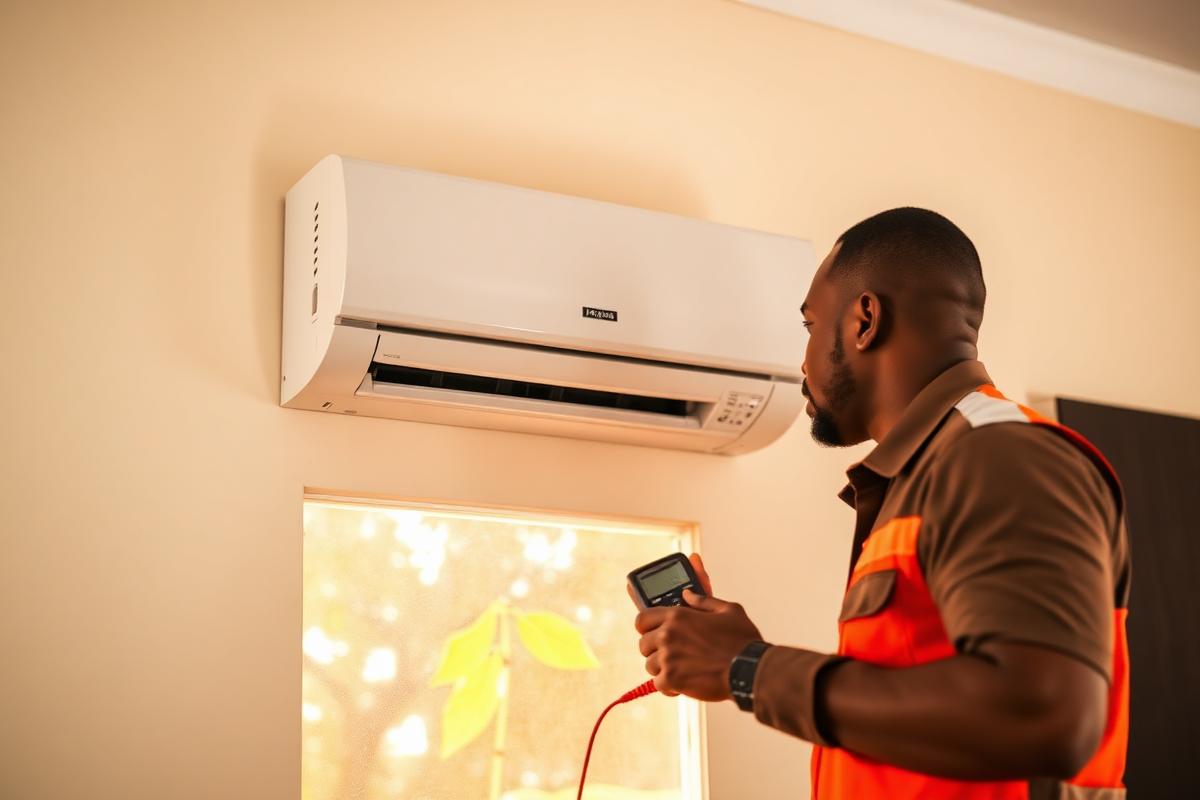
Why ACs fail more often during the Accra heat season
Between February and April, daytime temperatures in Accra and Tema regularly hit 33–35°C, and indoor heat loads spike. Split ACs that limped through the cooler harmattan period suddenly run flat-out for 10–12 hours a day — and any underlying weakness (low refrigerant, dirty coils, weak capacitor, voltage swings from dumsor) shows up immediately as warm air at the vent.
The Ghana Meteorological Agency publishes daily temperature and humidity forecasts for Accra, Kumasi and Tamale — useful context when you're trying to work out whether your AC is genuinely failing or just outmatched by a 36°C afternoon.
Step 1: Check the obvious before you call anyone
Confirm the remote is set to Cool mode (snowflake icon), not Fan or Dry, and the target temperature is below the room temperature — set it to 18–20°C for the test. If the indoor unit is running but you feel only room-temperature air, the compressor outside may not be kicking in.
Walk to the outdoor unit. Is the fan spinning? Can you hear the compressor humming? If the outdoor fan is dead but the indoor unit is on, you're almost certainly looking at a capacitor, contactor or compressor fault — stop and call a pro.
Step 2: Clean the filters (this fixes 1 in 3 cases)
Accra dust, harmattan haze and pet dander clog AC filters fast. A blocked filter chokes airflow across the evaporator coil, the coil ices over, and the unit blows warm air even though the compressor is working perfectly.
Open the indoor unit's front panel, slide out the two mesh filters, rinse them under a tap, let them dry fully, then refit. Run the AC on Cool at 18°C for 20 minutes. If air starts coming out properly cold, that was your fault.
Step 3: Inspect the outdoor (condenser) unit
The outdoor unit dumps your room's heat into the air outside. If it's hidden behind a wall, smothered by a generator housing, or caked in dust and leaves, it can't release heat — and the system loses cooling power even with a full gas charge.
Switch the AC off at the wall, then gently brush off any visible dust from the outdoor coil fins (don't bend them). Make sure there's at least 30–50 cm of clear space around the unit. Restore power and retest.
Step 4: Did dumsor or a power surge just hit?
Sudden voltage drops and surges from the grid are one of the top killers of AC compressors and capacitors in Ghana. If your AC stopped cooling right after a dumsor outage or a lightning storm, the capacitor or PCB is the most likely casualty.
Check ECG/NEDCo updates and outage schedules via the Electricity Company of Ghana, and seriously consider a voltage stabilizer or AVR rated for your AC's wattage — a GHS 350–800 stabilizer is far cheaper than a GHS 1,800+ compressor swap.
Step 5: Low refrigerant gas — the most common technician callout
If filters and the outdoor unit are clean and the AC has worked fine for 2+ years without service, low refrigerant is the next suspect. Tell-tale signs: ice forming on the copper pipe at the outdoor unit, hissing noises, or air that's slightly cooler than room temp but never cold.
Refrigerant doesn't get "used up" — if it's low, there's a leak. A reputable technician should pressure-test, find the leak, repair it, then recharge with the correct refrigerant. Modern units use R32 or R410A; the Ghana Environmental Protection Agency and the Energy Commission have phased out R22 imports, so refuse any tech who wants to top you up with it.
Typical repair costs in Accra and Tema (2026)
Filter clean & basic service: GHS 120–280. Outdoor coil deep clean: GHS 200–400. Capacitor replacement: GHS 80–200 plus part. Gas leak repair + R32/R410A recharge: GHS 350–850 depending on HP. Compressor replacement (1.5–2.0 HP): GHS 1,200–2,800 with part. PCB replacement on inverter splits: GHS 600–1,400.
For a wider price benchmark see our AC installation cost guide for Accra and Tema and the deeper AC installation & repair cost guide for Ghana.
When to stop DIYing and book a pro
Call a certified AC technician immediately if: the outdoor unit won't start, you smell burning, ice is visible on the copper pipes, the breaker keeps tripping, or the unit was hit by a power surge. Refrigerant work is regulated — only EPA-trained technicians should open the gas circuit.
Book a vetted AC technician on PROARTISAN HUB for same-day callouts across Accra, Tema, Kumasi and Takoradi. Every pro is ID-verified, reviewed by real customers, and prices are agreed before work begins.
Keep your AC alive through the next heat season
Service the unit twice a year — once before harmattan and once before the March/April heat peak. Run it on Cool not Auto when the room is hot. Fit a stabilizer. Close curtains during the hottest hours. And don't ignore small symptoms — a slightly weak AC today is a dead compressor in three months.
For more home maintenance reading, see our CCTV installation guide and generator servicing in Ghana.
Ready to book a verified pro?
Browse hundreds of vetted artisans and service providers across Ghana.
Explore services

